People, not numbersThe Popiela Family “Centrum” Foundation

Blog

Salomea Korzennik and Rachela Pacher

Translated from the Polish original.
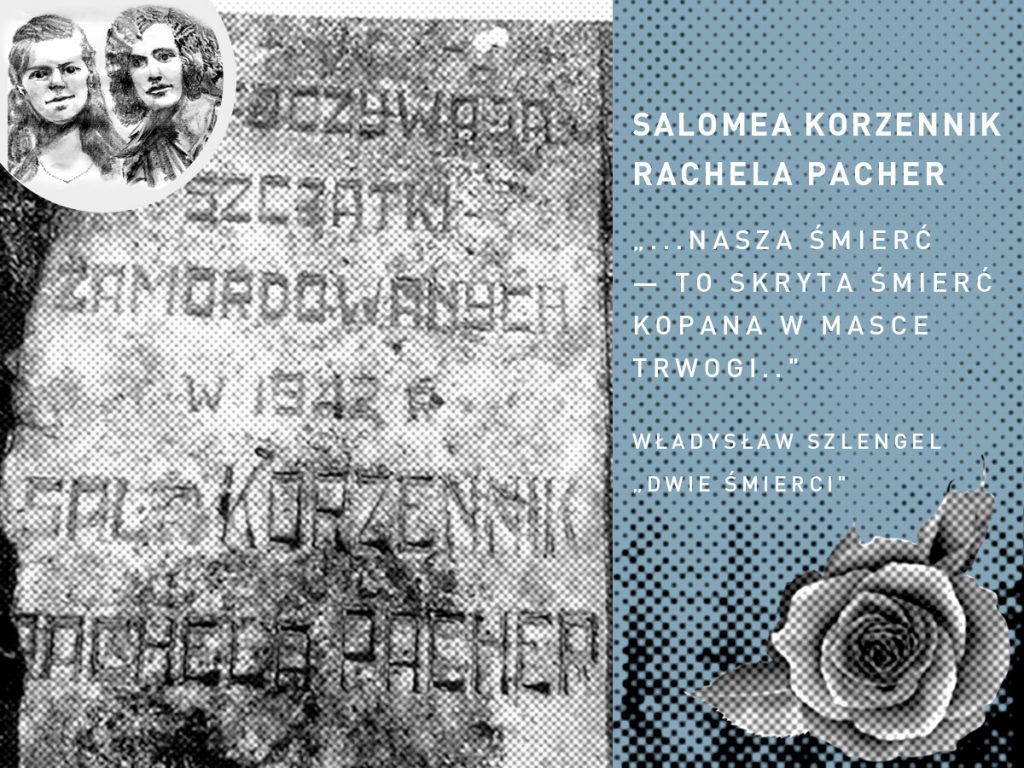
Responding to an appeal for help that Inga Marczyńska posted on Facebook last year, we took action, and together with Inga we are fighting for the memory and dignity of the victims #forthegirls.

12 August 1942. The Nazis drove all the Jewish inhabitants of Kołaczyce and the surrounding area onto the Błonie meadow in Kołaczyce. Promising them freedom, they ordered them to buy themselves out of the death transport with whatever valuables they had. Among those on the Błonie were the families of Salomea Korzennik from Sowina and Rachela Pacher, who were friends. The Jews camped near the market on the Błonie for several days. Two related Jewish families lived in Sowina: the Korzenniks and the Krygiels.

Salomea’s father, Edmund Korzennik, sent the girl home to Sowina for the ransom. Salomea left the market square on the Błonie together with her friend Rachela Pacher. The two of them went to Sowina, 7 km away, where the Korzennik family’s “valuables” were hidden in the barn of their nearest neighbour. On the way back, at the entrance to the square on the Błonie where the Jews were being held, a policeman stood in their way: a collaborator from Silesia, one Teodor Drzyzga (a pre-war officer of the Polish Army, a miner in civilian life). Drzyzga first robbed the girls, then raped and shot them. Almost all of Salomea’s and Rachela’s families were murdered and buried in a mass grave in Krajowice on 12 August 1942. Salomea’s father Edmund survived. At the place where the girls were murdered and buried, he made neighbours he knew promise to put up a memorial plaque. They kept their word. After the war all trace of Edmund disappears; we know nothing of his fate.

The death of these two young, beautiful Jewish girls did not pass unnoticed among the people of Kołaczyce. Right after the war, members of the Jewish community who had been close to the girls, and people from Kołaczyce, came to the place of the murder and burial. The family of the girls’ nearest neighbours and friends visited the grave. Through the efforts of people of goodwill, the girls’ burial place was entered in the register of war graves as a place important for our history and our memory.

A terrible, tragic story, like so many from the time of the Holocaust and the occupation. And yet it is exceptional, because 79 years later the story of these teenage girls (probably sixteen years old) continues. The property with the grave was sold and fenced off, with no way to reach the grave and pay due respect to the murdered girls. Despite its protection on paper, in practice the burial place does not look like a grave. Only a cracked slab with the girls’ names recalls the tragedy. The slab is often covered with rubble and rubbish. The owner does not believe the girls are buried there, and no communication with him is possible. For several months we fought hard for the girls’ dignity; in the next posts and a short film I will show the results of our work.

Deep respect to Inga for years filled with remembrance of the two friends. Thank you for letting me be part of such a noble and important struggle. Your help will be needed soon. When I often hear that the Holocaust is history from books, a closed chapter, soon each of you will be able to see that this is not true, because many stories reach their ending only after decades. As with the story of the girls: we cannot give them back their lives, but we will write a different ending to this tragedy, and each of you can be part of it.

Text: Inga Marczyńska, Dariusz Popiela.

Show the Polish original

Na apel o pomoc naszej  Inga Marczyńska z tamtego roku na FB podjęliśmy działania i wspólnie z Ingą walczymy o pamięć i godność ofiar #dladziewczynek.

12 sierpnia 1942 rok. na Błonie w Kołaczycach naziści zapędzili wszystkich żydowskich mieszkańców Kołaczyc i okolic. Obiecując im wolność, nakazali wykupić się z transportu śmierci, posiadanymi kosztownościami. Na Błoniach znalazła się również rodzina Salomei Korzennik z Sowiny oraz Racheli Pacher, przyjaciółek . Żydzi koczowali w okolicy targu na Błoniach parę dni. W Sowinie mieszkały dwie rodziny żydowskie: Korzennik i Krygiel (spokrewnione).
Ojciec Salomei, Edmund Korzennik, wysłał dziewczynę do domu w Sowinie po okup. Salomea wyszła z placu targowego na Błoniach, w towarzystwie koleżanki Racheli Pacher. Obie udały się do oddalonej o 7 km Sowiny, gdzie w stodole u najbliższego sąsiada ukryte były rodzinne „kosztowności” Korzenników. Wracając, u wejścia na plac na Błoniach, gdzie przebywali zapędzeni Żydzi, na ich drodze stanął policjant, kolaborant pochodzący ze Śląska niejaki Teodor Drzyzga ( przedwojenny oficer WP, w cywilu górnik). Drzyzga najpierw okradł, potem zgwałcił i zastrzelił dziewczynki. Niemal cała rodzina Salomei i Racheli została zamordowana i pochowana w zbiorowej mogile w Krajowicach 12 sierpnia 1942. Przeżył ojciec Salomei Edmund, który w miejscu mordu i jednocześnie pochówku dziewczynek zobowiąże znajomych sądiadów do wykonania pamiątkowej tablicy. Słowa dotrzymali. Po wojnie ślad po Edmuncie zanika nie wiemy nic o jego losie.
Śmierć tych dwóch młodych, ślicznych żydowskich dziewczyn nie obeszła się bez echa wśród mieszkańców Kołaczyc. Zaraz po wojnie na miejsce mordu i pochówku przyjeżdżała społeczność żydowska, bliska dziewczynkom i mieszkańcy Kołaczyc. Grób odwiedzała rodzina najbliższych sąsiadów i przyjaciół dziewczynek. Dzięki staraniom ludzi dobrej woli miejsce pochówku dziewczynek zostało wpisane do rejestru grobów wojennych jako ważne dla naszej historii dla pamięci.
Historia straszna, tragiczna jak wiele z czasów Zagłady z czasów okupacji. A jednak wyjątkowa bowiem 79 lat później historia kilkunastoletnich dziewczynek (prawdopodobnie 16-latek) ma swoją kontynuację. Posesja z grobem została sprzedana i ogrodzona bez możliwości dojścia do grobu i oddania należnej czci pomordowanym dziewczynkom. Pomimo teoretycznej ochrony w praktyce miejsce pochówku nie przypomina grobu. Jedynie pęknięta płyta z nazwiskami dziewczynek przypomina o tragedii. Płyta często zasypywana gruzem, śmieciami. Właściciel nie wierzy w pochówek dziewczynek nie możliwa z nim jest jakakolwiek komunikacja. Przez kilka miesięcy instensywnie walczyliśmy o godność dziewczynek w kolejnych wpisach i filmiku przybliżę efekty naszej pracy.

Wielki szacunek dla Ingi za lata przepełnione pamięcią o dwóch przyjaciółkach. Dzięki, że mogłem być częścią tak szlachetnej i ważnej walki dziękuję. Będzie potrzebna wkrótce wasza pomoc kiedy słyszę często, że Zagłada to historia z książek, zamknięty rozdział to niebawem każdy z was będzie mógł się przekonać, że to nieprawda bo wiele historii swoje zakończenie ma po dziesięcioleciach podobnie z historią dziewczynek życia nie przywrócimy ale dopiszemy inne zakończenie tej tragedii a każdy z was może być jego częścią.


Salomea Korzennik and Rachela Pacher

In response to the appeal our colleague Inga Marczynska for help from last year on FaceBook, we both took action and fought for the memory and dignity of the victims below.

August 12, 1942. on Błonie in Kołaczyce, the Nazis chased all the Jewish inhabitants of Kolaczyce and its vicinity. Promising them freedom, they ordered them to buy out the death transport with their valuables. The family of Salomea Korzennik from Sowina and Rachela Pacher, friends, also found their way to Błonia. The Jews camped near the market in Blonia for a few days. Two Jewish related families lived in Sowin: Korzennik and Krygiel. Salomea’s father, Edmund Korzennik, sent the girl to her home in Sowin for the ransom. Salomea left the market square in Błonie, accompanied by her friend Rachela Pacher. They both went to Sowina, 7 km away, where Korzennik’s family estate were hidden in the barn of the nearest neighbor.
On her return, at the entrance to the square in Błonia, where the exiledJews were detained, a policeman, a collaborator from Silesia, a certain Teodor Drzyzga (a pre-war Polish Army officer, a miner in civilian life) stood in their way. Drzyzga robbed, then raped and shot the girls. Almost the entire family of Salomea and Rachel was murdered and buried in a mass grave in Krajowice on August 12, 1942. Salomea’s father Edmund survived, and at the place of the murder and at the same time the girls’ burial, he will oblige his friends to make a commemorative plaque. They kept their word. After the war, the trace of Edmund disappears, we know nothing about his fate. The death of these two beautiful young Jewish girls did not go unnoticed among the inhabitants of Kolaczyce. Immediately after the war, the Jewish community, close to the girls and the inhabitants of Kolaczyce, came to the
place of the murder and burial. The grave was visited by the family of the girls’ closest neighbors and friends. Thanks to the efforts of people of good will, the girls’ burial place was entered in the war graves register as important for our history for memory.
A terrible, tragic history like many from the times of the Holocaust during the occupation. And yet the unique story of teenage girls (probably 16 years old), 79 years later, has its continuation. The property with the grave was sold and fenced in, without the possibility of reaching the grave and paying due respect to the murdered girls. Despite theoretical protection, in practice the place of burial does not resemble a grave. Only a cracked plate with girls’ names reminds us of the tragedy. The slab is often covered with rubble and rubbish. The owner does not believe in the burials of the girls, no communication is possible with him. For several months, we fought intensively for the dignity of girls in the next entries and in the video I will present the effects of our work.

Great respect for Inga for the years filled with the memory of the two murdered girls. Thanks for being part of such a noble and important fight, thank you. Your help will be needed soon, when I often hear that the Holocaust is a story from books, a closed chapter is soon each of you will be able to find out that it is not true because many stories have their ending after decades, similarly to the story of girls, we will not bring back life, but we will add a different ending of this tragedy and each of you can be a part of it.

Tekst: Inga Marczyńska,  Dariusz Popiela
Tłumaczenie:  Leszek Slisz