Dawid Grassgrün
Translated from the Polish original.
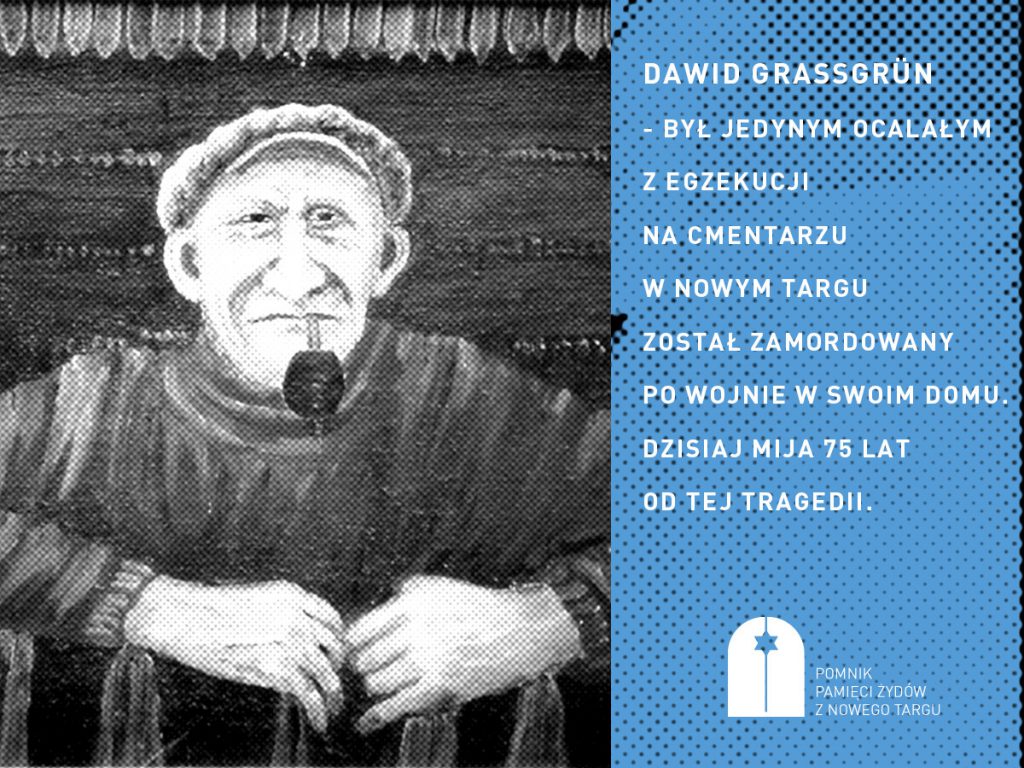
Today marks 75 years since the death of Dawid Grassgrün, as remembered by the Nowy Targ painter Karol Kostur. He was a farmer, a cab driver and a respected Nowy Targ “horse dealer”. He often took horses across the border, because in Czechoslovakia they fetched a much higher price, and on the way back he carried tobacco. At the beginning of the war he used his smuggling experience to help people who wanted to flee occupied Poland (including Polish officers), because as a forced labourer and coachman for the German Arbeitsamt (labour office) he was allowed to use his own horse and cab.
During the deportation action on 30 August 1942 Dawid hid in a stable. He could not persuade his wife Resi and their children to do the same. His daughter Chana and his sons Samek and Henryk were sent to concentration camps. Resi Grassgrün was murdered in Bełżec, and their youngest son, 17-year-old Emanuel, was shot at the Jewish cemetery in Nowy Targ. Dawid Grassgrün, dragged out of his hiding place, was to die there too. He was saved because he leased a field right next to the cemetery and knew which place in the cemetery fence made escape possible. He ran away naked just before the execution. Knowing the smugglers’ paths, he reached Kežmarok in Slovakia. He stayed in the flat of Józef Engländer, a Jew from Nowy Targ, whose daughters never forgot the sight of the broken older man in rags and the story he told. Dawid Grassgrün survived until the end of the war under a false name, looking after horses in Červený Kláštor and travelling around Spiš as a rag-and-bone man.
He was the only one to survive an execution at the Jewish cemetery in Nowy Targ, and the only older Jew from Nowy Targ to survive the Holocaust. After the war he founded the “Jewish Religious Association in Nowy Targ” and waited for his children and all the others who had survived to return. He was shot dead in his own home on Krzywa Street on 10 February 1946. Everything indicates that Dawid Grassgrün’s murderers were partisans of the “Błyskawica” group, men under the command of Józef Kuraś, “Ogień”.
Dawid Grassgrün’s funeral was the last Jewish burial at the Nowy Targ cemetery. Photographs of that day show the faces of his children, Chana and Samek, frozen with pain. Immediately afterwards all the surviving Jews of Nowy Targ left their town for ever.
Text: Karolina Panz.
Show the Polish original
Dzisiaj mija 75 lat od śmierci Dawida Grassgrüna, tak zapamiętanego przez nowotarskiego malarza Karola Kostura. Był rolnikiem, fiakrem i cenionym nowotarskim „końskim kupcem”. Często przeprowadzał konie przez granicę bo w Czechosłowacji płacono za nie znacznie wyższą cenę, w drodze powrotnej przewoził tytoń. Na początku wojny swoje doświadczenie w przemycie wykorzystywał do pomocy ludziom chcącym uciekać z okupowanej Polski (w tym polskim oficerom), bo jako pracownik przymusowy i woźnica niemieckiego Arbeitsamtu (Urzędu Pracy) mógł korzystać ze swojego konia i dorożki.
W czasie akcji wysiedleńczej 30 sierpnia 1942 r. Dawid ukrył się w stajni. Nie udało mu się namówić do tego żony Resi i dzieci. Córka Chana oraz synowie Samek i Henryk trafili do obozów koncentracyjnych. Resi Grassgrün zginęła w Bełżcu, a ich najmłodszy syn 17-letni Emanuel został rozstrzelany na nowotarskim cmentarzu żydowskim. Dawid Grassgrün wywleczony ze swojej kryjówki również miał tam zginąć. Uratowało go to, że dzierżawił pole tuż obok cmentarza i wiedział, które miejsce w cmentarnym płocie umożliwia ucieczkę. Zbiegł nago tuż przed egzekucją. Dzięki znajomości przemytniczych ścieżek dotarł do słowackiego Kieżmarku. Zatrzymał się w mieszkaniu nowotarskiego Żyda Józefa Engländera, którego córki na zawsze zapamiętały widok i opowieść załamanego i odzianego w łachmany starszego człowieka. Dawid Grassgrün przetrwał do końca wojny pod fałszywym nazwiskiem opiekując się końmi w Czerwonym Klasztorze i jeżdżąc po Spiszu jako handlarz starzyzną.
Był jedynym, który ocalał z egzekucji na nowotarskim cmentarzu żydowskim. Jedynym starszym wiekiem Żydem z Nowego Targu, który przeżył Zagładę. Po wojnie założył „Żydowskie Zrzeszenie Religijne w Nowym Targu” i czekał na powrót swoich dzieci i wszystkich, którzy przetrwali. Zginął zastrzelony we własnym domu przy ul. Krzywej 10 lutego 1946 r. Wszystko wskazuje na to, że mordercami Dawida Grassgrüna byli partyzanci ze Zgrupowania „Błyskawica” – podkomendni Józefa Kurasia „Ognia”.
Pogrzeb Dawida Grassgrüna był ostatnim żydowskim pochówkiem na nowotarskim cmentarzu. Na zdjęciach z tamtego wydarzenia widać skamieniałe z bólu twarze jego dzieci: Chany i Samka. Zaraz po nim wszyscy ocalali nowotarscy Żydzi na zawsze opuścili swoje miasto.
Dawid Grassgrün
Today it has been 75 years since Dawid Grassgrün died. The painter from Nowy Targ, Karol Kostura, made a portrait of him. He was a farmer, cabman and a sought-after „horse trader”. He would often take the horses through the border as their price was higher in Czechoslovakia. He brought tobacco on his way back. At the beginning of the war he used his experience in smuggling to help people who wanted to leave the occupied Poland (including Polish officers). As a forced laborer and driver of the German Arbeitsamt (job centre), he was allowed to use his horse and cab.
The funeral of Dawid Grassgrün was the last Jewish burial at the cemetery in Nowy Targ. In the pictures from that tme you can see the grief-stricken faces of his children: Chana and Samek. Right after all the surviving Jews left their town for good.
Tekst/Written by Karolina Panz
Tłumaczenie/Translated by Magdalena Macińska