[eng. below] W Nowym Sączu na rogu ulicy Sobieskiego i Lwowskiej stoi kamienica, która była własnością Kalmana Sieradzkiego, jednego z najbardziej znanych sądeckich cukierników. Właściciel zakładu urodził się w Kongresówce. W 1905 r. w zaborze rosyjskim miały miejsce strajki i rozruchy. Kalman zdecydował się wyjechać do Galicji, a na miejsce zamieszkania wybrał Nowy Sącz. Do 1939 r. żył pod adresem Lwowska 6. Wówczas także porzucił ortodoksję.
Był świetnym cukiernikiem. Firma rozwijała się prężnie, będąc jednym z kilku tego typu zakładów w centrum miasta. Ludzie zachwycali się Jego witryną, a niektórzy nawet… kradli słodkości.
Sieradzki był surowym szefem. Całą cukiernię i piekarnię ulokował na parterze swojej kamienicy. W 1922 r. w zakładzie zastrajkowano przeciwko wykorzystywaniu młodej siły roboczej… Był to jeden z pierwszych strajków w międzywojennym Sączu! Potem zmienił swoje podejście do pracowników i jako jeden z nielicznych nie znalazł się na „czarnej liście” Inspektoratu Pracy. Względem polskiego prawa, był czysty jak łza. Niemal…
Nie wszyscy tę lojalność doceniali: Przed wojną, kiedy wzrastały wpływy endecji, młodzi chłopcy z tego ugrupowania wybrali sobie cukiernie Sieradzkiego do prześladowania. To była jedna z nielicznych czynnych w niedzielę cukierni. Z racji, że sklep był przy Farze, to kiedy kończyła się msza, ludzie walili drzwiami i oknami do Sieradzkich. Jego cukiernia była słynna! Endecy stali z pałami przed sklepem i bili tych co w niedziele chcieli zrobić zakupy. Ponoć ci sami chuligani, po swojej „pracy” , przez tylne drzwi kupowali ciastka od Żyda Sieradzkiego.
Początek II wojny światowej to czas rozbicia rodziny. A Kalman z Chaną doczekali się wielu dzieci. Część z nich zginęła w Holokauście. Wojnę przeżył syn Karol (Charles), który walczył wraz z Armią Andersa. W czasie II wojny światowej Kalman i Chana mieli się ukrywać na cmentarzu żydowskim. Ich losy są ciężkie do ustalenia. Wiemy, że cukiernik wchodził przez jakiś czas w skład Judenratu. Niestety zginął w Nowym Sączu lub Bełżcu, zapewne w 1942 r. Część z Jego dzieci przeżyła wojnę, ale to już osobna historia…
Grafika Joanna Kurczap
Dziękuję
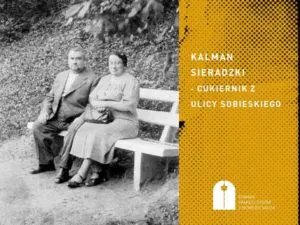
The tenement house on the corner of Sobieskiego and Lwowska Streets in Nowy Sącz used to belong to Kalman Sieradzki, one of the town’s most famous confectioners. Sieradzki was born in Congress Poland, within the Russian partition of the former Commonwealth of Poland and Lithuania. When strikes and riots broke out in the Russian partition in 1905, Kalman decided to move to Galicia and chose Nowy Sącz as his place of residence. He lived at 6 Lwowska Street until 1939, by which time he had abandoned Orthodoxy.
He was an excellent confectioner. Though there other such establishments in the city centre, his business thrived. People admired his shop window, and some even… stole the sweets.
Sieradzki located the entire confectionery and bakery on the ground floor of his tenement house. He was a strict boss. In 1922, a strike broke out in the factory against the exploitation of young labour force… It was one of the first strikes in interwar Sącz! Later on, Sieradzki changed his approach to workers and was one of the few not to be placed on the “black list” of the Labour Inspectorate. In terms of Polish law, he was squeaky clean. Almost…
Not everyone appreciated this loyalty: When the National Democrats (a Polish nationalist political movement) were gaining influence before WWII, young boys from this group chose Sieradzki’s confectionery as their target. It was one of the few confectioneries open on Sundays. As the shop was located next to the main parish church, people flocked to Sieradzki’s shop when the mass was over. His patisserie was famous! National Democracy members would stand in front of the shop with clubs and beat those who wanted to do shopping on Sundays. Allegedly, the same hooligans would buy cakes from Sieradzki the Jew through the back door, once they had completed their “work”.
The beginning of WWII brought about a breakup of the family. Kalman and Chana had many children, some of whom died in the Holocaust. Their son Karol (Charles), who fought with the Anders Army, survived the war. Kalman and Chana were said to have hidden in the Jewish cemetery during WWII. Their fate is difficult to establish. We know the confectioner was a member of the Judenrat for some time. Unfortunately, he died in Nowy Sącz or was murdered in the Bełżec extermination camp, probably in 1942. Some of his children survived the war, but that is another story…
Text Łukasz Połomski
Translation Adam Musiał
Graphic Joanna Kurczap
Thank You