Zvi Turner
Translated from the Polish original.
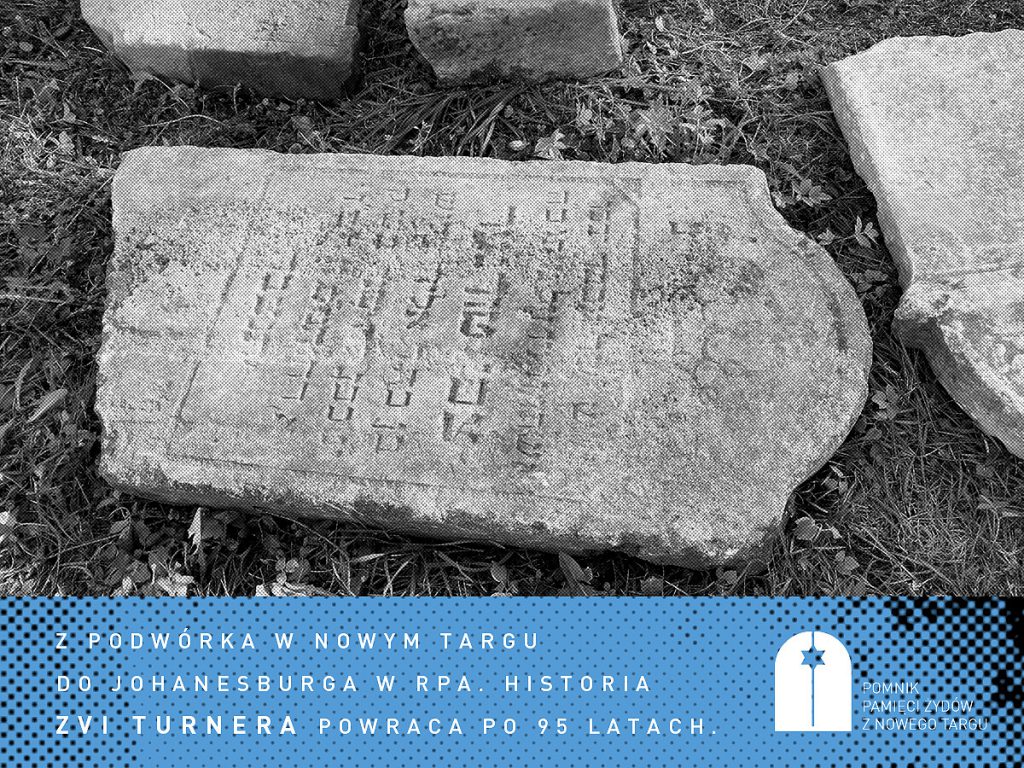
The remarkable story of a matzevah (tombstone) found in a backyard led us to Johannesburg in South Africa, where the granddaughter of the deceased lives. The stone commemorating a resident of Nowy Targ lay outside the cemetery for decades. Thanks to a newspaper article, an attentive resident of Nowy Targ got in touch with us. And thanks to Dr Karolina Panz’s post, you can see how much has been established, even though 95 years have passed since the death of Hersch Zvi Turner.
The matzevah, found a dozen or so days ago in a backyard in Nowy Targ, belonged to Hersch Turner. In 1919 Hersch married Eleonora (Lea). The newly-weds settled in Nowy Targ at 10 Ludźmierska Street, where Hersch ran a butcher’s shop. In the autumn of 1920 their first son, Józef Henoch (known to all as Heniek), was born; in the spring of 1922 a daughter, Hela Keila; in the summer of 1924 a son, Mojżesz; and on 6 September 1926 Cecylia was born. By then Hersch was already ill. He suffered greatly, and an operation for which he travelled as far as Berlin brought no result.
Heniek remembered his father as a very devout Jew who loved the Torah. A few weeks after Cecylia’s birth, on 22 October 1926, the Feast of Tabernacles (Sukkot) began. After returning from the synagogue, Hersch recited the kiddush (the blessing that opens the Sabbath and festivals) and ate the festive meal with his family. He died the next day, on the first day of Sukkot. In the Jewish calendar this was the 15th day of the month of Tishri, and it is this date that is carved on the recovered matzevah. Heniek, who lost his father a few days before his seventh birthday, remembered the crowds at the funeral and that among the mourners there were also Christians. As the eldest son, it was he who for the next eleven months recited the mourner’s Kaddish (Kaddish Yatom).
Eleonora, widowed at the age of 30, never remarried. Her son remembered her as an educated, energetic and beautiful woman who liked people, and who, with the support of her family, managed to combine running the butcher’s shop with raising her children alone.
During the war the Turners were in Nowy Targ. Eleonora was forbidden to sell meat, and all of them were made to do forced labour. Mojżesz was sent to work in the quarry in Zakopane, where the work was deadly dangerous. On 30 August 1942, 44-year-old Eleonora, 22-year-old Heniek, 20-year-old Hela and 18-year-old Cecylia reported to the stadium in Nowy Targ. Heniek was selected for a labour camp and taken by lorry to Czarny Dunajec. He never saw his mother and sisters again. He found his brother only in the next camp he was moved to, KL Plaszow in Kraków. From there they were sent to Brünnlitz, where Oskar Schindler employed them as carpenters. That saved their lives.
When they returned to Nowy Targ after the war, they found their house destroyed and none of their family. In the “Questionnaire for the registration of war damage”, certified by neighbours from Ludźmierska Street, Heniek wrote: “robbery by the occupier, destruction of the house and the ice house, and the murder of my mother and two sisters. Torture, beatings, starvation.”
Hersch Turner’s descendants live today in Israel and South Africa, and his granddaughter wants to come to Poland as soon as possible to see this remarkable discovery.
With thanks to Jolanta Kruszniewska for reading the inscription on the matzevah.
Show the Polish original
Niezwykła historia odnalezionej na jednym z podwórek macewy (nagrobka) doprowadziła nas do Johanesburga w RPA gdzie mieszka wnuczka zmarłego Kamień upamiętniający mieszkańca Nowego Targu przeleżał dziesięciolecia poza cmentarzem. Dzięki artykułowi w gazecie, czujność wykazał jeden z mieszkańców NT i skontaktował się z nami. A dzięki wpisowi dr Karolina Panz mogą Państwo zobaczyć jak wiele informacji pomimo upływu 95 lat od śmierci Herscha Zvi Turnera udało się ustalić.
Ta odnaleziona kilkanaście dni temu na jednym z nowotarskich podwórek macewa należała do Herscha Turnera. Hersch w 1919 r. poślubił Eleonorę (Leę). Nowożeńcy zamieszkali Nowym Targu przy Ludźmierskiej 10, gdzie Hersch prowadził zakład rzeźniczy. Jesienią 1920 r. przyszedł na świat ich pierworodny syn Józef Henoch (powszechnie nazywany Heńkiem), wiosną 1922 r. córka Hela Keila, latem 1924 r. syn Mojżesz, a 6 września 1926 r. urodziła się Cecylia. Hersch był już wtedy chory. Bardzo cierpiał, a operacja, na którą pojechał aż do Berlina, nie przyniosła rezultatu.
Heniek zapamiętał że jego ojciec był bardzo pobożnym, kochającym Torę Żydem. Kilka tygodni po narodzinach Cecylii, 22 października 1926 r., rozpoczynało się Święto Szałasów (Sukkot). Po powrocie z synagogi Hersch odmówił kidusz (modlitwę na rozpoczęcie szabatu) i spożył z rodziną świąteczną kolację. Zmarł następnego dnia w pierwszy dzień Sukkot. Według kalendarza żydowskiego przypadał on na 15 dzień miesiąca Tiszri i to właśnie ta data została wykuta na odnalezionej macewie. Heniek, który stracił ojca na kilka dni przed swoimi siódmymi urodzinami, zapamiętał tłumy na jego pogrzebie i to, że wśród żałobników byli też chrześcijanie. To on jako najstarszy syn przez 11 kolejnych miesięcy odmawiał kadisz sierocy (kadisz jatom).
Eleonora, która została wdową w wieku 30 lat nigdy nie wyszła ponownie za mąż. W pamięci syna zachowała się jako wykształcona, pełna energii piękna i lubiąca ludzi kobieta, której dzięki wsparciu bliskich udało się pogodzić prowadzenie zakładu rzeźniczego z samotnym macierzyństwem.
W czasie wojny Turnerowie byli w Nowym Targu. Eleonorze zabroniono sprzedaży mięsa i wszyscy pracowali przymusowo – Mojżesza wysłano na roboty do zakopiańskiego kamieniołomu, gdzie praca była śmiertelnie niebezpieczna. 30 sierpnia 1942 r. 44-letnia Eleonora, 22-letni Heniek, 20-letnia Hela i 18-letnia Cecylia stawili się na nowotarskim stadionie. Heńka przeznaczono do obozu pracy i wywieziono na ciężarówce do Czarnego Dunajca. Nigdy więcej nie zobaczył swojej matki i sióstr. Brata odnalazł dopiero w kolejnym obozie do którego go przewieziono – KL Plaszow w Krakowie. Stamtąd trafili do Brunnlitz, gdzie Oskar Schindler zatrudnił ich jako cieśli. To uratowało im życie.
Kiedy wrócili po wojnie do Nowego Targu zastali zburzony dom i nikogo z bliskich. W poświadczonym przez sąsiadów z Ludźmierskiej „Kwestionariuszu dotyczącym rejestracji szkód wojennych” Heniek zapisał: „rabunek dokonany przez okupanta, zburzenie domu, lodowni oraz zamordowanie matki i dwóch sióstr. Katowanie, bicie głodzenie”.
Potomkowie Herscha Turnera żyją dziś w Izraelu i RPA a wnuczka Herscha chce jak najszybciej przybyć do Polski zobaczyć niezwykłe odkrycie.
Dziękuję Jolanta Kruszniewska za odczytanie inskrypcji z macewy
Zvi Turner
This matzevah, which was found a dozen days ago in one of the yards in Nowy Targ, belonged to Hersch Turner. In 1919 Hersch married Eleonora (Lea). The newlyweds settled down in Nowy Targ at 10, Ludźmierska street where Hersch ran a butchery. In Autumn 1920 their oldest son was born – Józef Henoch (he was called „Heniek”). In Spring 1922 they had their oldest daughter Hela Keila, and in Summer 1924 their son Mojżesz, and on 6th September 1926 Cecylia. At that time Hersch was already ill. He suffered greatly and even surgery, which he had in Berlin, did not help.
Heniek remembered his father as a very pious and Torah-loving Jew. A few weeks after the birth of Cecylia on 22nd October 1926, it was the start of the Feast of Tabernacles – Succoth. Upon his return from the synagogue, Hersch recited the Kiddush (prayer for the beginning of the Shabbat) and had the holiday dinner. He died the next day – on the first day of the Succoth. According to the Jewish holida,y this was the 15th day of the Tishri month and it was this date that was engraved on the found matzevah. Heniek, who had lost his father a few days before his seventh birthday, remembered the crowds at his funeral and that there were Christians were among the mourners. It was him as the eldest son who recited the Mourner’s Kaddish (Kaddish Yatom).
Eleonora, who became a widow at the age of 30, never remarried. Her sons remembered her as an educated, lively and friendly woman, who thanks to the help of her loved ones, managed to balance running the butchery with single motherhood.
The Turner family was in Nowy Targ during the war. Eleonora could no longer sell her meat and all of the family members were forced laborers. Mojżesz was sent to work in a quarry in Zakopane where work was lethally dangerous. On 30th August 1942 44-year old Eleonora, 22-year old Heniek, 20-year old Hela and 18-year old Cecylia turned up at the stadium in Nowy Targ. Heniek was directed to work in a labor camp and taken to Czarny Dunajec in a truck. He never saw nor his mother nor his sisters again. He found his brother only in another camp to which he was taken – KL Płaszów in Kraków. From there they were taken to Brunnlitz where Oskar Schindler employed them as carpenters. This saved their lives.
Upon their return to Nowy Targ, they found their house in ruins and none of their loved ones. In the “Questionnaire concerning registering the war damage” authenticated by the neighbors, Heniek wrote: “Plunder by the occupant, destruction of the house, the ice house and killing of mother and two sisters. Torture, beatings, starvation.”
Descendants of Hersh Turner are still living in Israel and South Africa.
Thank You Jolanta Kruszniewska for reading the matzevot
Thank You Magdalena Macinska for the English translation