Salomon Kannengiesser
Translated from the Polish original.
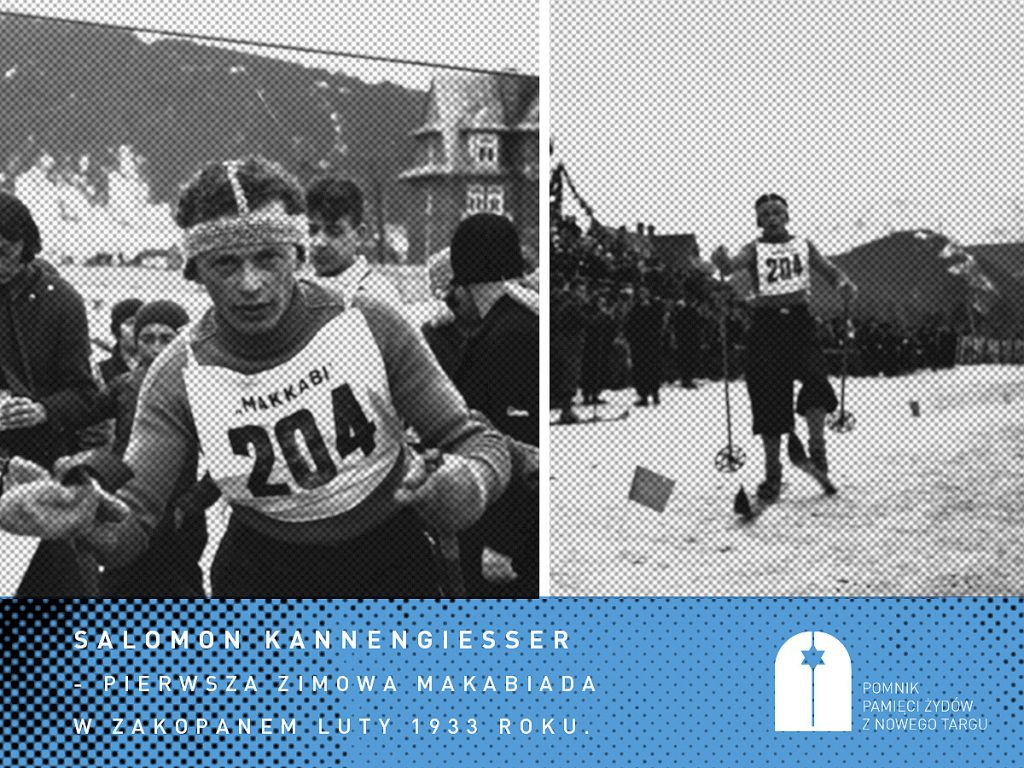
Another story, more people who, like us, once made plans and had dreams. As an athlete, when I see the start number I know what Salomon felt at the start of such an important sporting event: the nerves, the thrill, and the release when you set off, when you feel you are doing what you love, when you feel free. I can only guess what he felt when what he loved was taken from him. Together with the FIS World Cup, the Maccabiah was the largest pre-war sporting event in Zakopane. Here is a post by Karolina Panz.
In February 1933 a press photographer captured 27-year-old Salomon Kannengiesser, a tailor from Nowy Targ, during the 18-kilometre race at the first Winter Maccabiah in Zakopane. In January 1942, like all non-German inhabitants of occupied Poland, he had to hand over his skiing equipment. In his case that meant two pairs of skis and one pair of poles. In Nowy Targ, where cross-country and downhill skiing were very popular, almost 500 pairs of skis were collected. The 13-page list includes both Polish and Jewish owners of skiing equipment, and it is the last shared list of Poles and Jews from Nowy Targ, apart from the prison records.
That winter the German authorities also demanded Jewish furs and all fur goods. Salomon Kannengiesser did not hand over everything: he hid some things with Polish friends, and he paid the highest price for it. He was shot on 18 June 1942 in a forest near Nowy Targ.
The whole Kannengiesser family was murdered in the Holocaust: Salomon’s sisters Rachela, Helena (with her husband Józef Langer and their little son Szymon) and Maria (with her husband Chaim Juda Günsberg), and his brothers Izaak, Abraham (with his wife Tauba Chaja, his son Salomon and his daughter Fela) and Jakub (with his wife Felicja and their little son Szymon).
Show the Polish original
Kolejna historia, kolejni ludzie, którzy kiedyś jak my planowali, marzyli. Jako sportowiec widząc numerek startowy wiem co czuł Salomon w chwili startu na tak ważnej imprezie sportowej. Stres, dreszcz emocji i wyzwolenie kiedy ruszysz, kiedy czujesz, że robisz to co kochasz, czujesz wolność. Mogę natomiast tylko przypuszczać co czuł kiedy odebrano mu to co kochał…. Makabiada była wraz z Pucharem Świata FIS największymi przedwojennymi imprezami sportowymi w Zakopanem. Zapraszam na wpis Karoliny Panz ( Karolina Panz ).
W lutym 1933 r. fotoreporter uchwycił w kadrze 27-letniego nowotarskiego krawca Salomona Kannengiessera w czasie biegu na 18-kilometrów podczas pierwszej zimowej Makabiady w Zakopanem. W styczniu 1942 r. podobnie jak wszyscy nieniemieccy mieszkańcy okupowanej Polski musiał oddać swój sprzęt narciarski. W jego przypadku były to dwie pary nart i jedna para kijków. W Nowym Targu, w którym narciarstwo biegowe i zjazdowe było bardzo popularne, zebrano prawie 500 par nart. Na 13-stronicowym wykazie ujęto polskich i żydowskich właścicieli sprzętu narciarskiego i jest to ostatnia, poza więzienną, wspólna lista Polaków i Żydów z Nowego Targu.
Tamtej zimy władze niemieckie zażądały także żydowskich futer i wszelkich wyrobów futrzanych. Salomon Kannengiesser nie oddał wszystkiego – część rzeczy ukrył u znajomych Polaków i zapłacił za to najwyższą cenę. Zginął rozstrzelany 18 czerwca 1942 r. w nowotarskim lesie.
W czasie Zagłady zginęła cała rodzina Kannengiesserów – siostry Salomona: Rachela, Helena (wraz z mężem Józefem Langerem i synkiem Szymonem) i Maria (wraz z mężem Chaimem Judą Günsbergiem) oraz bracia: Izaak, Abraham (z żoną Taubą Chają, synem Salomonem i córką Felą) i Jakub (z żoną Felicją i synkiem Szymonem).
Salomon Kannengiesser
In February 1933 a photo reporter caught a 27-year old tailor Salomon Kannengiesser while doing an 18-kilometre run in the first Winter Maccabiah Games in Zakopane. In January 1942 just as the other non-German inhabitants of the occupied Poland he had to give away his skiing equipment. In his case there were two pairs of skis and one pair of ski poles. In Nowy Targ, where cross-country skiing and downhill skiing were very popular, almost 500 pairs of skis were collected. Polish and Jewish owners of skiing equipment were listed in a 13-page were listed and this is probably the last (aside for the list of prisoners) common list of Poles and Jews from Nowy Targ.
That winter the German authorities demanded Jewish furs and all fur products. Salomon Kannengiesser did not give everything away – he hid some with Polish friends and he paid the highest price. He was shot on 18th June 1942 in the forest of Nowy Targ.
During the Holocaust all the family of Kannengiesser died – Salomon’s sisters: Rachela, Helena (with her husband Józef Langer and son Szymon), Maria (with her husband Chaim Juda Günsberg) and the brothers: Izaak, Abraham (with his wife Tauba Chaja, son Salomon and daughter Fela), Jakub with ( his wife Felicja and son Szymonek).