The Beldegrün family
Translated from the Polish original.
Here is a post by Dr Karolina Panz recalling the story of the Beldegrün family. Poverty touched many people in Podhale. With no large industry, a harsh climate and weak economic development, life in the region was far from easy. The story of the Beldegrün family and Henryk’s account give us a glimpse of the daily struggle of his anxious mother, Helena (Chaja), to keep the family alive.
When reconstructing the fates of Jews from small towns, one of the greatest challenges is the stories of those who owned no house, shop or business: poverty erases the archival traces of a person’s existence. In 1934, 127 Jews of Nowy Targ (about 5% of the community) lived in extreme poverty. That number grew considerably after the flood that struck Nowy Targ in July 1934. Among the poor and the flood victims were Helena (Chaja) and Adolf Beldegrün. They had four children. One daughter died just after birth, another, Esterka, at the age of four; Henryk and Ela survived. Adolf lost his job at a timber yard at the very start of the economic crisis, and the haulage firm he founded collapsed. He suffered a breakdown and later fell ill with tuberculosis. The household was kept by Helena, who sewed trousers that were sold at the Nowy Targ fair. The flood caught them in a rented flat that could not be used for a year after the water went down. That summer Adolf’s health declined rapidly; he died in September 1934. This is how Henryk Beldegrün remembered his mother’s everyday life: “From the funeral we came back home, to our sad life. Mother turned to another way of earning, because she could not support the family by sewing. She went round the better-off families, taking orders for poultry and dairy produce. Whatever the weather, she had to travel on an open cart every Monday to the fair in Czarny Dunajec, every Wednesday to the fair in Jabłonka, and every Thursday she bought at the fair in Nowy Targ. On Monday the cart left for Dunajec at about half past five in the morning, so mother got up at half past four, and she came home at about five or six in the evening. The cart to Jabłonka left at about half past three in the morning, so mother had to get up at about half past two, and she came back at about seven or eight in the evening, and sometimes, when the road was hard, especially in winter, much later. She had to carry the bundles and baskets of poultry and dairy produce herself, of course. All of it weighed about 60 kilograms. When she got home, all the poultry had to be taken to the slaughterer, then it had to be plucked, which often lasted until midnight, and on Wednesdays sometimes the whole night. The Thursday purchases had to be dealt with on the third night, and so it went on, round and round, for whole weeks, months and years. Everything essentially had to be sold by midday on Friday, because later no one would buy it, as they would not have time to prepare it for the Sabbath. Only towards evening did mother hastily prepare something for Saturday and clean the flat at the same time. On Saturday mother slept a little longer and came back to herself. On Sunday she was still stripping goose feathers.”
The “Record card of confirmations issued for registered trades, craft cards and licences” of Helena (Chaja) Beldegrün notes that she was self-employed, buying dairy produce and selling vegetables, and that her workplace was the markets and fairs of the Nowy Targ district. Dozens of Jews in Nowy Targ earned their living in a similar way.
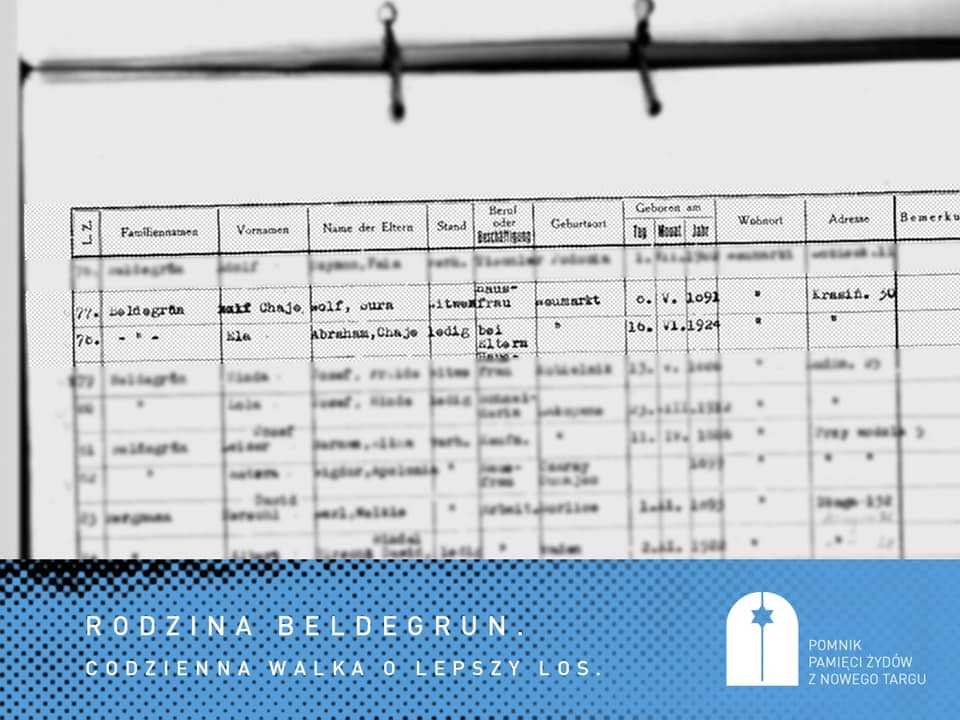
No photograph of Helena has survived. That she and her 18-year-old daughter Ela were most probably murdered in Bełżec, when Helena was 41, is shown by a small pencil mark beside their name, which made it easier to count how many wagons were needed for the transport to the death camp.
Show the Polish original
Zapraszam na wpis dr Karolina Panz , który przypomina historię rodziny Beldegrun. Bieda na Podhalu dotykała wielu mieszkańców. Brak wielkiego przemysłu, surowy klimat, słaby rozwój gospodarczy powodowały, że życie w tym rejonie do lekkich nie należało. Dzięki historii rodziny Beldegrun i relacji Henryka uzyskujemy wgląd w codzienną ciężką walkę zatroskanej matki Heleny (Chai) o byt rodziny.
W odtwarzaniu losów Żydów z niewielkich miejscowości, jednym z największych wyzwań jest są historie tych, którzy nie posiadali własnego domu, sklepu, czy przedsiębiorstwa – ubóstwo zaciera archiwalne ślady czyjegoś istnienia. W 1934 r. 127 nowotarskich Żydów (około 5% ich społeczności) żyło w skrajnej nędzy. Liczba ta znacznie się powiększyła na skutek powodzi, która dotknęła Nowy Targ w lipcu 1934 r. Wśród ubogich i poszkodowanych przez powódź byli Helena (Chaja) i Adolf Beldegrünowie. Mieli czworo dzieci. Jedna z córek zmarła zaraz po urodzeniu, kolejna – Esterka, w wieku czterech lat, przy życiu pozostali Henryk i Ela. Adolf stracił pracę w składzie drewna na samym początku kryzysu ekonomicznego, a założona przez niego firma przewozowa upadła. Załamał się psychicznie, a później zachorował na gruźlicę. Dom utrzymywała Helena, szyjąca spodnie sprzedawane na nowotarskim jarmarku. Powódź zastała ich w wynajętym mieszkaniu, które po opadnięciu wody przez rok nie nadawało się do użytku. Tego lata stan zdrowia Adolfa gwałtownie się pogorszył – zmarł we wrześniu 1934 r. Tak Henryk Beldegrün zapamiętał codzienność swojej matki: „Z pogrzebu wróciliśmy do domu, do naszego smutnego życia. Matka przeszła na inny sposób zarobkowania, gdyż z szycia nie była w stanie utrzymać rodziny. Chodziła ona po bogatszych rodzinach, zbierając od nich zamówienia na zakup drobiu oraz nabiału. Zmuszona była bez względu na pogodę jeździć odkrytą furmanką co poniedziałek do Czarnego Dunajca na jarmark, co środę do Jabłonki na jarmark i co czwartek robiła zakupy na jarmarku w Nowym Targu. W poniedziałek wyjazd do Dunajca następował około godziny 5.30 rano, a więc matka wstawała już o godz. 4.30, przyjazd do domu następował około godziny 17-18. Wyjazd do Jabłonki następował około 3.30 rano, a wiec matka musiała wstawać około godz. 2.30 rano, a przyjeżdżała około godz. 19-20, a czasami, jak była ciężka droga szczególnie zimą znacznie później. Toboły, koszyki z drobiem i nabiałem musiała oczywiście sama dźwigać. Ważyło to wszystko około 60 kg. Po przyjeździe do domu, trzeba było cały drób nieść do rzeźnika, następnie trzeba było oskubać, co trwało nieraz do północy, a w środy nieraz i całą noc. Zakup z czwartku trzeba było opracować w trzecią noc i tak to trwało na okrągło przez całe tygodnie, miesiące i lata. Upłynniać to wszystko trzeba było w zasadzie do obiadu w piątek, gdyż w późniejszych godzinach nikt by tego nie kupił, gdyż nie zdążył by tego przygotować na sobotnie święto. Pod wieczór dopiero matka coś przygotowywała na chybcika na sobotę i jednocześnie sprzątała mieszkanie. W sobotę matka trochę odsypiała i przychodziła do siebie. W niedzielę jeszcze darła pierze z gęsi”.
Na „Karcie spisu na wydane potwierdzenie zgłoszenia przemysłów, karty rzemieślnicze i koncesje” Heleny (Chai) Beldegrün odnotowano, że wykonuje wolny przemysł skupując nabiał i sprzedając warzywa, a miejscem jej pracy są targi i jarmarki powiatu nowotarskiego. W podobny sposób zarabiały na życie dziesiątki nowotarskich Żydów.
Nie zachowała się żadna fotografia Heleny. O tym, że w wieku 41 lat razem ze swoją 18-letnią córką Elą zginęły najprawdopodobniej w Bełżcu, świadczy niewielki widniejący przy ich nazwisku i wykonany ołówkiem znaczek, który ułatwiał podliczenie ilości wagonów koniecznych do transportu do obozu zagłady.
Beldegrün family
Please read the post by Dr Karolina Panz about the history of the Beldegrün family. Poverty in the Podhale region, resulting from the lack of big industry, a harsh climate, and poor economic conditions, affected many inhabitants, making their lives difficult. Thanks to the history of the Beldegrün family and Henryk’s testimony, we can gain an insight into the hard daily struggle of his mother Helena (Chaja) for the family’s existence.
One of the greatest challenges in recreating the fate of Jews from small towns is to recover the stories of those who did not have their own house, shop or business, as poverty obliterates the archival traces of a person’s existence. 127 Jews from Nowy Targ (about 5 per cent of the Jewish community) lived in extreme poverty in 1934. This number increased significantly as a result of the flood that hit Nowy Targ in July that year. Helena (Chaja) and Adolf Beldegrün were among the poor to have been affected by the flood. They had four children. One of the daughters had died shortly after her birth, another one, Esterka, passed away at the age of four, and only Henryk and Ela remained alive. Adolf had lost his job in a timber yard at the very beginning of the economic crisis, and the shipping company he had founded collapsed. He broke down mentally and later fell ill with tuberculosis. Helena maintained the house by sewing trousers that were sold at the fair in Nowy Targ. The flood found them in a rented apartment, which was unusable for a year after the water level had fallen. Adolf’s health deteriorated rapidly that summer, and he died in September 1934. This is how Henryk Beldegrün remembered his mother’s everyday life: “We returned home from the funeral, to our sad life. Mother switched to a different way of earning a living, as she was unable to support our family by sewing. She would knock on the doors of wealthier families, collecting orders for the purchase of poultry and dairy products. Regardless of the weather, she had to drive an open cart to the fair in Czarny Dunajec every Monday, the fair in Jabłonka every Wednesday, and the fair in Nowy Targ every Thursday, where she did the shopping. On Mondays, she would leave for Czarny Dunajec around 5.30 am, so she had to get up at 4.30 am, and she would return home around 5-6 p.m. She would leave for Jabłonka around 3.30 am, so she had to get up around 2.30 am, and she would return home around 7-8 pm, and sometimes, especially in winter, when the conditions were difficult, she would be back much later. Of course, she had to carry the bundles and the poultry and dairy baskets herself. All this weighed about 60 kg. After arriving back home, all the poultry had to be taken to the butcher’s, and then it had to be plucked, which sometimes lasted until midnight, and on Wednesdays even all night long. The Thursday purchase had to be processed on the third night, and so it went on like this for weeks, months and years on end. In practice, it all had to be sold away by Friday lunch, because no one would have bought it later, as they would not have had the time to prepare it for Shabbat. And only in the evening would my mother prepare something for Saturday on the fly and clean the apartment at the same time. On Saturdays, she would make up for lost sleep a little and bounce back. And on Sundays, she would pluck goose feathers.”
Helena (Chai) Beldegrün’s “List of the confirmations received for the registered industries, handicraft cards and licences”, stated that she was self-employed in buying dairy products and selling vegetables, and that her workplace was the markets and fairs of the Nowy Targ district. Dozens of Nowy Targ Jews earned their living in a similar way.
No photograph of Helena has survived. She was most probably murdered in Bełżec at the age of 41 with her 18-year-old daughter Ela. This is evidenced by a small pencil mark by their surname, which made it easier to count the number of train cars necessary for transport to the extermination camp.
For english Dziękuję/Thank You Adam Musiał