Lonek and Ludwik
Translated from the Polish original.
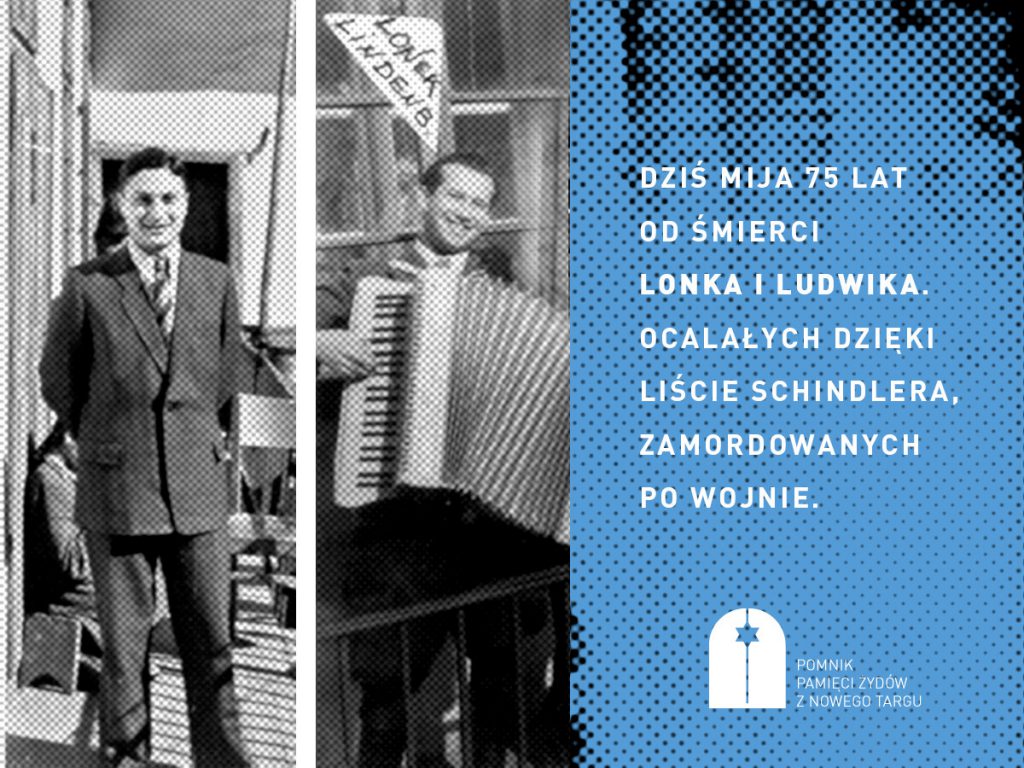
Today is the 75th anniversary of the deaths of Salomon Lindenberger and Ludwik Herz, residents of Nowy Targ murdered in their own town after the war.
Salomon (Lonek) Lindenberger and Ludwik Herz came from well-to-do families. Lonek was a pupil at the secondary school in Nowy Targ. His photograph as a graduate of 1939 still hangs there. His father, Eliasz, owned the largest grocery and colonial goods shop on the Nowy Targ market square, which was taken from him in December 1939. From then on he and his son did manual work for the new owners of the business without receiving any pay. They lived by selling off their belongings for food. Lonek’s parents were murdered in Bełżec at the end of August 1942. His teenage sister Nina tried to hide with a Polish family; she was killed in the autumn of 1942. After the selection at the Nowy Targ stadium on 30 August 1942, the twenty-one-year-old Lonek was sent to the labour camp at the SS and SD police school in Rabka.
In the “Questionnaire concerning war damage” completed in 1945, the twenty-year-old Ludwik Herz wrote that the damage done to his family had taken place in Nowy Targ, Zakopane and Kraków: “[…] they took away the furniture. They murdered my parents. They demolished the villa in Zakopane.” The Herz family was evicted from their house in Zakopane; their land was taken, the law office was closed down, and their antique furniture and valuable paintings were looted. In 1941 and 1942 the Herz family had to pay a total of 10,000 złoty in forced contributions, and for two years Ludwik did forced labour in Nowy Targ for the Austrian firm Moritz. Later he too was sent to the labour camp in Rabka. One of its prisoners testified: “I remember how once, together with others, we were shovelling gravel onto a lorry. Among us, assigned to load the gravel, was a young boy named Ludwik Herz, from Nowy Targ. Herz had no skill at shovelling gravel onto the lorry, and every time he threw a shovelful, the gravel flew over to the other side or fell just short of the lorry. The result was that Badura [the lorry overseer] beat him badly, even though Herz cried and explained that he was not yet used to it and could not yet load gravel the way the others already could.”
In the spring of 1943 Lonek and Ludwik were taken from Rabka to Płaszów. It is not known how or when they came to be among the Jews employed by Oskar Schindler at the Brünnlitz labour camp. Herz, number 68866, worked as a painter; Lindenberger, number 68997, as a locksmith’s assistant. The Gross-Rosen records (Brünnlitz was its subcamp) give 21 October 1944 as their date of arrival and 8 May 1945 as the end of their stay and the day of their liberation. Their names appear among thirty-seven others on the “List of persons registered in Nowy Targ” drawn up just after the war. Several post-war photographs of them survive. It was Ludwik Herz, who lived above the post office in Nowy Targ, who sent out the invitations to the first commemoration of the town’s Holocaust victims. Like almost all the survivors from Nowy Targ, they left the town after the murder of Dawid Grassgrün.
On 20 April 1946 it was the second day of Pesach for Jews and Holy Saturday for Christians. Salomon, Ludwik and three other people (Beniamin Rose, Ruth Joachisman and Henryk Unterbuch) were driving through Nowy Targ on their way to the Czechoslovak border. They wanted to leave communist Poland. Their car was stopped in a street in Nowy Targ by Józef Kuraś, known as “Ogień”, and a group of his partisans. Henryk, aged 42, tried to run; he was killed by shots to the head and chest. Lonek, 24, Ludwik, 22, Ruth, 21, and Beniamin, 33, were ordered to lie face down in a ditch. They were killed by shots to the back of the head.
The next day, in the church in Ostrowsko, “Ogień” solemnly married Czesława Polaczykówna, a young woman from Nowy Targ and a neighbour of Ludwik Herz. Her father had been seen at the execution the day before. The funeral of the five victims took place in Kraków on 23 April 1946. Hundreds of mourners can be seen in the photographs.
Show the Polish original
Dzisiaj przypada 75 rocznica śmierci Salomona Linderbergera i Ludwika Herza, mieszkańców Nowego Targu zamordowanych w swoim mieście już po wojnie.
Salomon (Lonek) Lindenberger i Ludwik Herz pochodzili z zamożnych rodzin. Lonek był uczniem nowotarskiego liceum. Jego zdjęcie jako absolwenta z 1939 r. nadal tam wisi. Jego ojciec, Eliasz, miał największy sklep kolonialny przy nowotarskim Rynku, który mu odebrano w grudniu 1939 r. Odtąd wraz z synem pracowali fizycznie u nowych właścicieli firmy, nie otrzymując w zamian żadnej zapłaty. Utrzymywali się wyprzedając swoje rzeczy w zamian za żywność. Rodzice Lonka zginęli w Bełżcu pod koniec sierpnia 1942 r. Jego kilkunastoletnia siostra Nina próbowała ukrywać się u polskiej rodziny – zginęła jesienią 1942 roku. Dwudziestojednoletni L. Lindenberger po selekcji na nowotarskim stadionie 30 sierpnia 1942 r., trafił do obozu pracy przy Szkole Policji SS i SD w Rabce.
W „Kwestionariuszu dotyczącym szkód wojennych”, sporządzonym w 1945 r. dwudziestoletni Ludwik Herz napisał, że szkód wyrządzonych jego rodzinie dokonano na terenie Nowego Targu, Zakopanego i Krakowa: „[…] meble wywieźli. Rodziców zamordowali. Willę w Zakopanem zburzyli”. Rodzinę Herzów wysiedlono z ich domu w Zakopanem, zabrano im też ziemię i zlikwidowano kancelarię adwokacką, zrabowano antyczne meble i cenne obrazy. Rodzina Herzów w roku 1941 i 1942 musiała zapłacić łącznie 10000 złotych kontrybucji a Ludwik przez dwa lata pracował przymusowo w Nowym Targu w austriackiej formie Moritz. Później i on trafił do obozu pracy w Rabce. Jeden z jego więźniów zeznał: „Pamiętam, jak pewnego razu wraz z innymi nasypywaliśmy szuter na auto. Między nami do nasypywania tego szutru był przeznaczony młody chłopak, nazwiskiem Ludwik Herz, pochodzący z Nowego Targu. Herz nie miał wprawy w nasypywaniu łopatą tego szutru na auto – i co rzucił łopatą szutru na auto – to szuter przelatywał na drugą stronę, albo spadał tuż przed autem, skutek tego był taki, że Badura [nadzorca aut] dotkliwie go pobił, mimo że Herz płakał i tłumaczył się, że nie ma jeszcze wprawy i nie umie jeszcze nasypywać szutru tak, jak to inni robili już wprawnie”.
Wiosną 1943 r. Lonek i Ludwik zostali wywiezieni z Rabki do Płaszowa. Nie wiadomo, w jaki sposób i kiedy znaleźli się wśród Żydów zatrudnionych przez Oscara Schindlera w obozie pracy Brunnlitz. Herz z numerem 68866 był zatrudniony jako malarz, Lindenberger, z numerem 68997 jako pomocnik ślusarza. W kartotekach Gross Grosen (Brunnlitz był jego filią) jako ich datę przybycia odnotowano 21 października 1944 r. Za datę końcową ich pobytu i dzień ich wyzwolenia, podano 8 maja 1945 r. Ich nazwiska widnieją wśród trzydziestu siedmiu innych, w sporządzonym tuż po wojnie „Wykazie osób zarejestrowanych w Nowym Targu”. Zachowało się ich kilka powojennych fotografii. To Ludwik Herz, który mieszkał nad siedzibą nowotarskiej poczty, wysyłał zaproszenia na pierwsze nowotarskie upamiętnienie tamtejszych ofiar Zagłady. Podobnie jak prawie wszyscy ocalali z Nowego Targu opuścili miasto po zamordowaniu Dawida Grassgrüna.
20 kwietnia 1946 r. dla Żydów przypadał drugi dzień Pesah, dla chrześcijan Wielka Sobota. Salomon, Ludwik oraz trzy inne osoby (Beniamin Rose, Ruth Joachisman i Henryk Unterbuch) przejeżdżali przez Nowy Targ w drodze ku granicy z Czechosłowacją. Chcieli wyjechać z komunistycznej Polski. Ich samochód został zatrzymany na jednej z nowotarskich ulic przez Józefa Kurasia „Ognia” i grupę jego partyzantów. 42-letni Henryk próbował uciekać – zginął od strzału w głowę i pierś. 24-letniemu Lonkowi, 22-letniemu Ludwikowi, 21-Ruth i 33-letniemu Beniaminowi kazano położyć się w rowie twarzą do ziemi. Zginęli od strzału w tył głowy.
Następnego dnia w kościele w Ostrowsku odbył się uroczysty ślub „Ognia” z Czesławą Polaczykówną, nowotarżanką, sąsiadką Ludwika Herza. Jej ojca widziano poprzedniego dnia przy egzekucji. Pogrzeb pięciu ofiar odbył się 23 kwietnia 1946 r. w Krakowie. Na fotografiach uwieczniono setki żałobników.
Lonka i Ludwik
Today is the 75th anniversary of death of Salomon Linderberg and Ludwik Herz, the inhabitants of the Nowy Targ, who were murdered in their town after the war.
Salomon (Lonek) Lindenberger and Ludwik Herz both came from wealthy families. Lonek was the student of the local secondary school. His photo as a graduate from 1939 is still on display in the school.
His father, Eliasz had owned the biggest colonial store in the Nowy Targ Market Square, which the Germans confiscated in December 1939. Since then he and his son had worked for the new owners, doing manual labor without pay. They supported themselves by selling off their belongings in exchange for food. Lonek’s parents were killed in Bełżec in late August 1942. His teenage sister Nina tried to hide with a Polish family; she lost her life in autumn of 1942. After a selection carried out in Nowy Targ stadium on August 30 1942, Lonek was sent to a labor camp run by the SS police school in Rabka.
In the „Questionnaire regarding registration of wartime losses” completed in 1945, twenty-year-old Ludwik Herz wrote that his family had suffered losses in Nowy Targ, Zakopane, and in Cracow. „[They] took the furniture. Murdered the parents. Pulled down the villa in Zakopane.” The Herzes were evicted from their house in Zakopane, they also lost their land and their law firm; they were robbed of antique furniture and valuable paintings. In 1941 and 1942 the Herz family was made to pay a forced contribution amounting in total to ten thousand zlotys. Ludwik was compelled to do forced labor in Nowy Targ working for an Austrian company, Moritz. Later he was also sent to a labor camp in Rabka. A former inmate of that camp testified: „I remember when, together with others, I was loading gravel on a truck. A young boy by the name of Ludwik Herz from Nowy Targ was among us, sent to load that gravel. Herz had no experience in loading gravel with a shovel onto a truck, so that each time he threw a shovel-load, the gravel landed on the other side of the truck or fell short of it, with the result that Badura [a man supervising the trucks] beat him severely, even though Herz was crying and explaining that he hadn’t had any practice in loading gravel and he couldn’t do it as skillfully the others could”.
In Spring 1943 Lonek and Ludwik were deported from Rabka to Płaszów. It is not known how and when they joined the group of Jews employed by Oskar Schindler in the labor camp Brunnlitz. Herz, prisoner number 68866, worked as a painter. Lindenberger, number 68997, worked as an assistant toolmaker. 21 October 1944 is noted in the Gross-Rosen camp’s files (Brunnlitz was a sub-camp of the Gross-Rosen concentration camp system) as the day of their arrival. 8 May 1945 is given as the last day of their imprisonment and the date of their release. Their names are among thirty-seven others on the „List of persons registered in Nowy Targ”. A few post-war photographs have been preserved. This is Ludwik Herz, who lived above the post office, he would send invitations to the first commemoration of the Holocaust victims. As almost all the survivors of the Nowy Targ he left the town upon the murder of Dawid Grassgrün.
20 th April 1946 was the second day of Passover for Jews and the Easter Saturday for Christians. Salomon, Ludwik and three other people (Beniamin Rose, Ruth Joachisman and Henryk Unterbuch) were going through Nowy Targ on their way to the the border with Czechoslovakia. They wanted to leave Communist Poland. Their car was stopped by Józef Kuraś „Ogień” and the group of his partisans. 42-year old Henryk tried to run – he was shot in the head and in the chest. 24- year old Lonek, 22-year old Ludwik, 21-year old Ruth i 33- year old Beniamin were made lie down with their faces to the ground. They were shot in the back of their head.
The next day a solemn mariage ceremony of „Ogień” with Czesława Polaczykówna from Nowy Targ, the neighbor of Ludwik Herz, took place in Ostrowsko. Her father was seen the day before during the execution. The funeral of the five victims took place on the 23rd April 1946 in Kraków. You can see hundreds of mourners in the photos.